The missing 35%: what the $725 billion AI bet means for your marketing hire
Anthropic's data shows 65% of marketing tasks are AI-automatable. The 35% that survives is where every growth decision lives.
Anthropic's data shows 65% of marketing tasks are AI-automatable. The 35% that survives is where every growth decision lives.
Published on 18 May 2026
Open the US Department of Labor's O*NET database. Look up Marketing Manager, occupation 11-2021.00. Navigate to the Technology Skills section.
You'll find IBM Domino listed. McAfee VirusScan. Citrix. The database was updated in 2026. Not one AI tool is mentioned.
The official job description for one of the most AI-exposed roles in the entire economy hasn't caught up with reality. The function it describes is already half-automated, but the spec sheet doesn't know it. And if the job description is obsolete, there's a reasonable chance your hiring approach is too.
This matters because most of the conversation about AI and marketing has focused on what's at risk: the tools being automated away, the roles under pressure, the talent pool shifting. Less attention has gone to the more useful question. What exactly survives, why does it survive, and what does that tell you about how to staff a marketing function in 2026?
The answer starts with a number. 65%. And then it gets more interesting from there.
Anthropic published its Labour Market Impacts report in March 2026. It introduced a new measure called Observed Exposure, which combines theoretical AI capability scores with real usage data from actual Claude deployments. Not projections about what AI might one day do, but what it's already doing.
Marketing ranked 5th of 800 occupations for AI exposure. Anthropic's analysis found that 65% of marketing tasks are automatable using AI tools that already exist. (Anthropic, March 2026)
That 65% is broadly what founders picture when they think about marketing: content generation, data compilation, campaign reporting, SEO optimisation, social scheduling, email drafting, A/B test setup. The execution layer. The part that can be systemised, templated, and run at scale.
The business case for automating this layer is real and immediate. AI tools cost between $20 and $200 per seat per month, against $5,000 to $15,000 for a human equivalent. The ROI is visible within a month, not years. (TechCrunch, Dec 2025) This is why four companies - Microsoft, Google, Amazon, and Meta - are spending $725 billion on AI infrastructure in 2026, more than Sweden's entire GDP, up 77% from last year. Wall Street expects that figure to top $1 trillion by 2027. (Statista/CNBC, 2026)
That kind of capital doesn't get allocated because AI can now schedule LinkedIn posts. It gets invested because the investors are betting on replacing large-scale human labour at machine efficiency. The 65% is being priced into the market.
Gartner's survey from May 2026 shows where adoption currently sits. In marketing, 16% of work is currently automated by AI. Marketing leaders expect that to reach 36% by 2028. (Gartner, May 2026) If that doubling rate continues every two years, Anthropic's 65% ceiling arrives well before most hiring plans account for it.
Capability is already ahead of adoption. Most companies are still in the early stages of discovery.
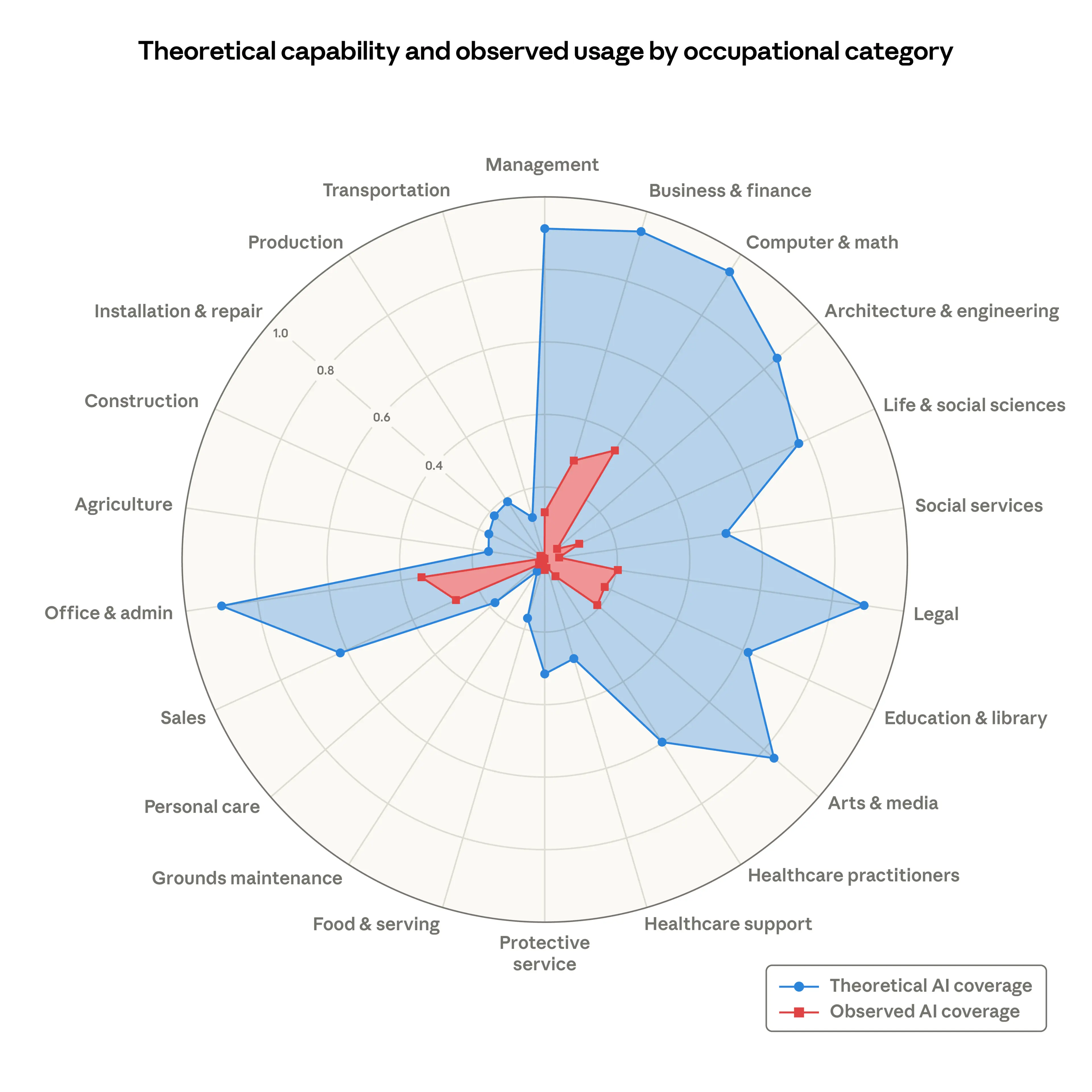
Most commentary on AI and marketing stays focused on the 65%. The fear-mongering, the tool recommendations, the "stay relevant" career advice. The more interesting question is what's in the other number.
If 65% is automatable, what exactly is in the 35% that isn't?
The same O*NET database that lists IBM Domino as a relevant technology skill also scores every work activity for Marketing Managers by importance, on a scale of 0 to 100. The top five activities, all scored above 80, are:
These aren't soft skills or peripheral activities. They're where every meaningful growth decision lives. Which market to enter. Which story to tell to which stakeholder. Whether a campaign is landing or just generating activity. Reading the room when one person loves your product but can't sign the cheque, and the other person can sign it but barely knows you exist. Reframing technical merit as commercial urgency when the board asks why the marketing budget hasn't moved a number yet.
None of this lives in a dataset that an AI can use to make decisions. The judgment involved is relational, contextual, and often depends on what wasn't said.
A BCG and Harvard study, surfaced in Jessica Apotheker's TED talk, found that AI improves individual creative performance by about 40%. The less obvious finding is that when teams over-rely on AI, the collective divergence of ideas drops by roughly 40%. (Apotheker, TED, 2023)
AI makes you faster at generating average. It makes you worse at being original. The 35% is where differentiation is created, and it's where every growth decision you'll make this quarter actually gets decided.
Most founders - particularly in tech - think the choice is binary. Hire a full-time marketing person, or use AI tools and build your own system.
The first option is expensive, slow, and increasingly hard to staff well. Anthropic's data shows hiring of younger workers in AI-exposed occupations slowed by 14% compared with 2022. The junior marketing talent pipeline is thinning at exactly the moment the senior judgment layer matters more. Senior marketers are cautious about moving until a new model has been established. If you do manage to find the right person, the process typically takes six months and the first year costs more than most founders budgeted for marketing itself. (Anthropic, March 2026)
The second option gives you volume without direction. With the right systems it's entirely possible to produce and distribute content faster than ever. Without someone experienced making the judgment calls, the result is polite interest and nice comments - but nothing actually moving. Tech-led founders often go this route, only to develop a growing suspicion that the smart tooling and good content output isn't doing anything useful inside their business. Research suggests this is because 87% of companies are investing in AI tools without first describing the workflow they are trying to improve.
The gap between the 16% automated today and the 65% eventual ceiling matters because pace matters. The cost of bad judgment used to be a wasted afternoon writing the wrong blog post. Now it's a wasted week distributing the wrong message across six channels at machine speed. As AI handles more of the execution layer, the judgment calls don't become less important - they become more important, because the reputational damage can be amplified by the technology itself.
This is also why marketing problems that look like execution problems are often judgment problems in disguise. More output, distributed faster, doesn't resolve a positioning gap. It often makes it more visible.
There's a better architecture. Not AI or a human, but a part-time senior human combined with an AI execution system, working together as a complete marketing function. That's the same shift we walk through in marketing strategy for founder-led businesses: positioning decided first, then a system that runs without every call funnelling through you.
The senior person owns the 35%: strategy, positioning, relationships, and creative direction. The judgment calls that require context living in actual conversations and relationships, not in datasets. AI handles the 65%: content production, analysis, reporting, the work that scales with compute rather than headcount. One side builds and maintains the system. The other runs it.
In practice this looks like someone senior spending a day or two a week embedded in a business. They're not writing the blog posts - the AI does that. They're deciding what the blog posts should be about, who they're for, and whether the messaging still matches what customers actually say when they buy. They're in the room when a positioning decision needs to be made. They review AI output before it ships. They build the marketing function as a system. The AI operates it.
This isn't a new concept at scale. It's what every company above a certain size already does - just with a full-time CMO, a team, and a substantial tech stack. The fractional version is the same architecture at founder-led scale. A fractional marketing director who understands both the AI engine and the human judgment layer, without requiring a full-time seat or a full-time salary.
For context on what this looks like in practice, fractional marketing arrangements typically cost 40-65% less than full-time equivalents and are operational within weeks rather than months. The 42% failure rate for full-time CMO hires within 18 months also suggests the traditional model carries more risk than most founders account for.
There's an additional dimension worth naming. Gartner found that half of consumers actively prefer brands that don't use AI-generated content. (Gartner, May 2026) The 35% of marketing that AI can't handle isn't just about skills - it's about earning trust. Someone must decide when to use AI and when to use a human voice. That takes experience and judgment, not just better prompts.
If you're thinking about the structural questions of AI adoption before you build this model out, this piece on AI adoption as a change management challenge is worth reading first.
Four things that don't require any budget:
The 35% audit. List your last 10 marketing decisions. How many required judgment about people, positioning, or timing? How many were execution tasks - writing, scheduling, reporting, optimising? That ratio tells you what you're missing. If most of your time goes to the 65%, you're doing AI's job by hand. If the 35% decisions are being made in your head at 11pm, they're probably not getting your best thinking.
The JD test. Pull up any marketing job spec you've written or received in the last year. Count how many listed skills are now AI-automatable. If it's more than half, you're hiring against an obsolete template. The role you actually need looks nothing like the one you'd post. If the skills section lists anything resembling IBM Domino, you might want to start from scratch.
The system check. Look at your current marketing setup. Is anyone specifically responsible for the judgment calls? Which audience. Which message. Which channel. When to stop. If the answer is "sort of everyone" or "sort of no one," that's the gap the 35% describes. AI can run the system. But someone needs to have built it first.
The 11pm test. When was the last time a marketing decision kept you at your desk after everyone else logged off? That decision probably sits in the 35%. It's worth asking whether the margins of your evening are really the best place for it.
For founders also thinking about AI strategy more broadly, the risk of building AI strategy on generic model outputs is worth understanding before you build the execution layer out at scale.
The O*NET database still lists IBM Domino as a relevant technology skill for Marketing Managers in 2026. The official job description for one of the most AI-exposed roles in the economy hasn't updated for a landscape that's already fundamentally changed.
That gap, between the official taxonomy and the actual work, is where most hiring mistakes happen. Founders write job specs against a template that was already half-automated when they started, hire against that spec, and wonder six months later why nothing moved.
The 65/35 split gives you a cleaner frame. The 65% is real and the automation economics are compelling. But the 35% - relationships, decisions, creativity, influence, strategy, all scored 80+ by the US Department of Labor - is where every growth decision you'll make this year actually happens. That part isn't going anywhere.
Someone still needs to make the calls AI can't. The question is whether that someone is you at 11pm, or a part-time leader who does this for a living.
If you're running a £2-7m business and marketing decisions still funnel through you at standup, that's what we built the Momentum Model for.
P.S. - If this resonated but you're not ready to talk yet, the Polything newsletter has more like this. One email a week, founder-focused, no fluff. Subscribe here.
Explore more insights and strategies to elevate your marketing approach.
Fired an agency, lost a freelancer, promoted the wrong person into marketing. How founder-led firms (£2–7m) evaluate a fractional marketing consultant.
Is fractional marketing worth it? Five myths about fractional marketing, tested against real client patterns, from cost worries to who actually does the work.
87% of companies waste £18k a year on AI tools. The problem isn't the tech — nobody described the workflow first. A 5-question framework for founders.