
Why Your Value Proposition Is Stuck at Level 1 (And How to Climb)
Most founders sell from the bottom of Bain's Value Pyramid - functional benefits - then wonder why they compete on price. Here's how to climb to emotional and life-changing value.
Most founders sell from the bottom of Bain's Value Pyramid - functional benefits - then wonder why they compete on price. Here's how to climb to emotional and life-changing value.
Published on 27 February 2026
Most bootstrapped founders fight a price war because they're selling the wrong thing. They're selling a feature, not a feeling. "We audit contracts." "We install cavity wall insulation with an R-value of 3.5." "We automate payroll." Every one of those statements tells me what you do. None of them tells me what I become.
CB Insights found that 42% of startups fail because there is "no market need." Yet most of them had a working product. The need was real. The message just never landed because it described a function, not a feeling. Research from the IPA shows that emotional campaigns outperform rational ones on almost every business metric. The optimal split is roughly 60% emotional, 40% rational. Most founders are running that ratio backwards.
This article walks through the structure behind why some propositions command premium fees and others get ignored: the Bain Value Pyramid, how it connects to Jobs-to-Be-Done, and how four real UK companies climb from functional to emotional and life-changing value. You'll get a 10-minute exercise you can use before your next sales call.
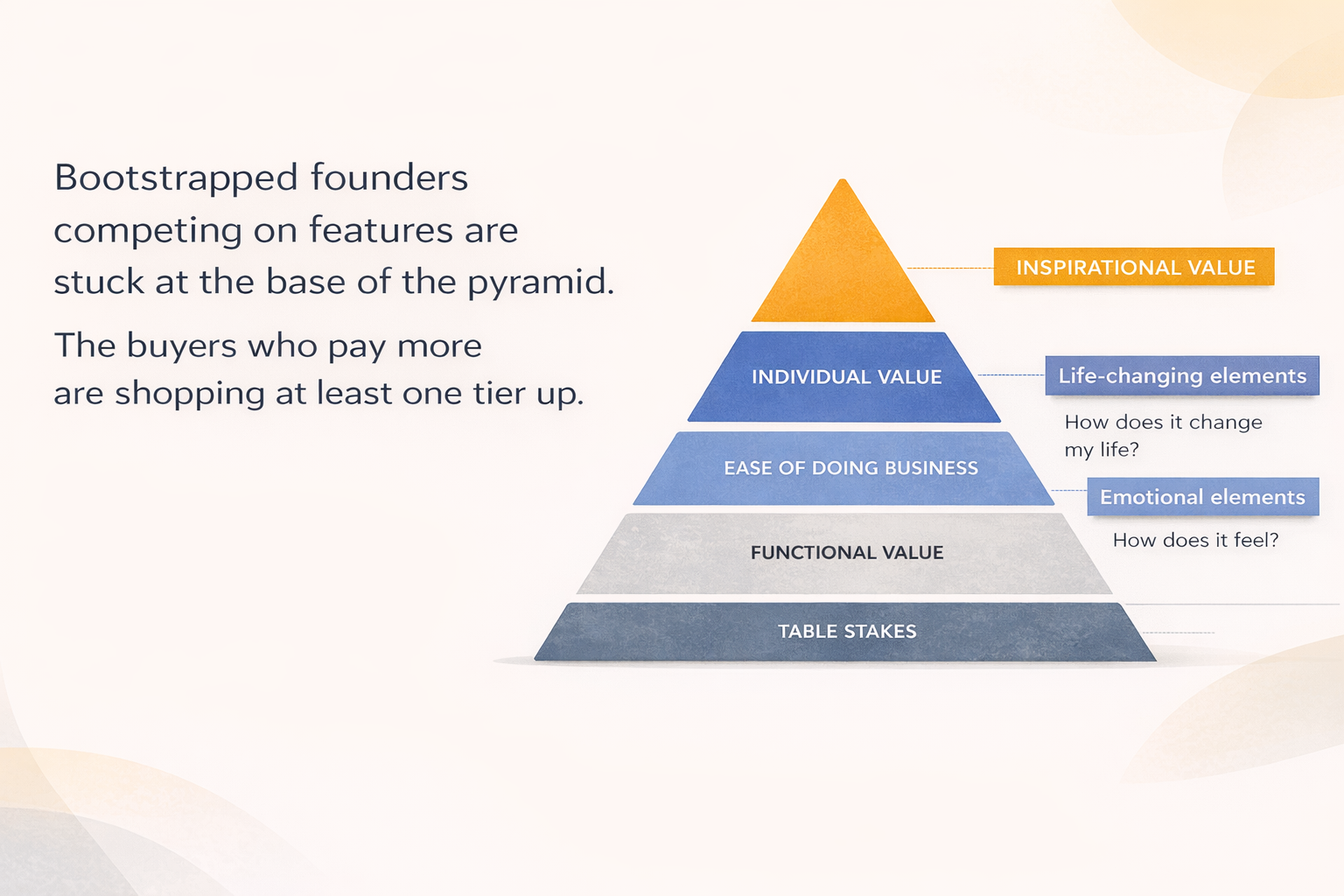
The Bain Value Pyramid, from Harvard Business Review's "Elements of Value" research, has four tiers. Understanding them changes how you price, how you pitch, and how long your customers stay.
Tier 1: Functional. Saves time, reduces cost, simplifies, reduces risk, organises, integrates. This is where roughly 90% of bootstrapped founders stop. It's necessary. But it's never enough for premium positioning, because your competitor can match every spec on this tier. When specs match, the buyer defaults to price.
Tier 2: Emotional. Reduces anxiety, rewards me, makes me feel safe, proud, in control. This is where differentiation begins. Rewriting a functional benefit as an emotional one doesn't require changing your product. Just your language. Bain's own research puts a number on it: adding an emotional element is worth 50% more revenue impact than adding a functional one.
Tier 3: Life-Changing. Hope, self-actualisation, belonging. This is where churn drops and referrals start. When customers feel their identity is wrapped up in your product, they don't leave for a 10% cheaper alternative. Emotional connections make customers two to three times more likely to stay.
Tier 4: Social Impact. Contributing to something bigger than yourself. Especially powerful for retrofit and green energy founders: "You're not just insulating a house. You're part of the movement to decarbonise UK housing stock."
Clay Christensen's Jobs-to-Be-Done work sharpens this. His milkshake study found that commuters bought a morning milkshake not for its taste, but for comfort and control during a boring drive. Competitors kept tweaking flavours, a purely functional move, and missed the real job entirely. When you pair JTBD interviews with the pyramid, you surface the latent job that functional claims can't explain, then layer on the emotional and identity benefits your competitors are ignoring.
Four real companies, one per segment, show the same pattern: one audience, one outcome, one emotional promise.
Elmhurst Energy sits in the retrofit space. Their functional pitch: "We provide EPC accreditation and training for energy assessors." Solid. Specific. But it lives entirely on Tier 1. Their emotional climb takes them from accreditation provider to something bigger: security, professional identity, and being part of the national infrastructure that future-proofs UK homes. CREDS research backs this: retrofit buyers are motivated by feeling safe, proud and in control, not by energy bill savings alone. In regulated sectors, owning one category with evidence beats vague "sustainability" messaging. But evidence alone doesn't close deals. You need to name the feeling. See the full Elmhurst breakdown for the tier-by-tier analysis.
Legl serves law firms. Most legal tech leads with "compliance software." Legl leads with what changes: less admin, fewer risk gaps, one place for the client journey. The emotional climb goes from "we digitise onboarding" to "you feel in control of legal risk" to "you're the firm that modernises without disrupting client relationships." One audience, one outcome. Same service described at two different tiers means two different levels of willingness to pay. See the full Legl breakdown.
Snugg helps homeowners navigate retrofit. Most home-energy platforms lead with technical specs. Snugg leads with the journey: plan, grants, installers, finance, all in one place. The emotional climb moves from "check your postcode" to "feel confident your home is sorted" to "you're the homeowner who took control." Their partner proof (TSB, NatWest, EDF, Which?) does the emotional heavy-lifting that specs never could. See the full Snugg breakdown.
CharlieHR sells HR software to small teams. Their narrative, chaos to clarity, works because it matches how founders actually feel. The emotional climb: from "manage payroll and holiday in one place" to "stop worrying about the admin that keeps you up at night" to "you're the founder who built a team that feels looked after." Small teams want to see themselves in the story. Not the feature list your dev team shipped. See the full CharlieHR breakdown.
Dollar Shave Club proved the same thing with a $4,500 video that led with identity and humour, not blade specs, and built a billion-dollar exit. A UK consultant proved it by charging £25,000 for a strategic pivot instead of £200 an hour. The pitch wasn't "200 hours of work." It was "confidence that your new direction generates £500k in revenue."
You'll know it's working when the buyer stops asking about price and starts asking how to get started. Research from Stripe shows 84% of B2B buyers prioritise how a company makes them feel when it's time to renew, not the feature list.
Professional services firms stuck in the hourly trap, retrofit founders whose buyers see them as "expensive or nice to have," and bootstrapped SaaS founders with high churn all share the same root problem: they're selling from the bottom of the pyramid when the money and the loyalty live at the top. If your value proposition feels right but doesn't convert, the subjective filters in the buyer's mind are often the cause; climbing the pyramid is how you pass through the emotional resonance filter.
We've broken down Elmhurst, Legl, CharlieHR, Snugg and Moneypenny, tier by tier, with scores. Explore them all on the Value Proposition Insights hub. If you want help making this a structured process rather than guesswork, that's what Value by Design is built for. One thing worth checking first: whether the issue is the level of your proposition, or a deeper strategic clarity gap that more marketing activity won't resolve.
Features get you a seat at the table, but it's emotions that get you the order.
Explore more insights and strategies to elevate your marketing approach.
Fired an agency, lost a freelancer, promoted the wrong person into marketing. How founder-led firms (£2–7m) evaluate a fractional marketing consultant.
Is fractional marketing worth it? Five myths about fractional marketing, tested against real client patterns, from cost worries to who actually does the work.
87% of companies waste £18k a year on AI tools. The problem isn't the tech — nobody described the workflow first. A 5-question framework for founders.